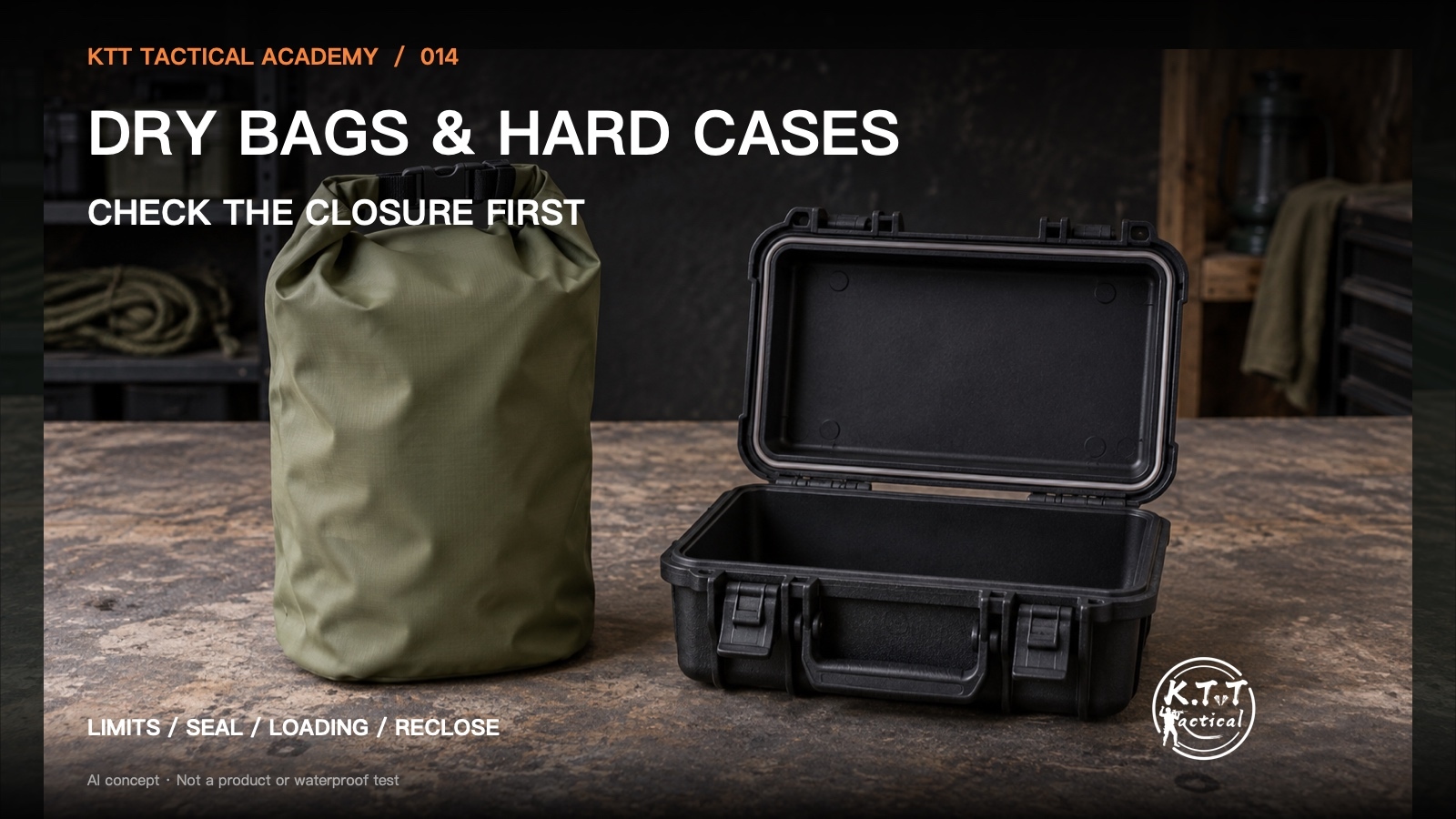
Your phone, spare clothing and documents are packed. Is the closure ready too? After our previous discussion of IP ratings, this issue moves to the part you handle: the roll-top and fabric on a dry bag, and the sealing surfaces and closure on a hard case. Start there before deciding whether the container suits the trip.
AI-generated concept image. It does not depict a specific product, demonstrate a closure procedure or provide waterproof-test evidence.
What the manufacturers confirm
A waterproof body does not remove the closure limit
The Sea to Summit Lightweight Dry Bag FAQ advises against submersion because water can enter through the roll-top. A statement about the bag fabric therefore cannot stand in for a statement about the complete closure. [1]
Its closure guide calls for inspecting the fabric and inner coating and not using a damaged bag. After packing and expelling excess air, fold over the sealing strip, make at least two further rolls in the same direction and secure the buckle. Follow the instructions for the actual model in your hands. [2]
A hard case still needs a model-specific check
Pelican lists a silicone O-ring lid seal and automatic pressure-equalization valve for the 1500 Protector Case. Sea to Summit also warns that fine sand must not interfere with an O-ring case seal. These details identify inspection points; they do not establish equal protection across all hard cases. [3][2]
KTT observation: describe the exposure first
The following sequence is KTT's planning guidance, not a new manufacturer specification or test result. Write down the expected exposure, the sensitivity of the contents and how often you will open the container. A clothing bag used in rain and a container protecting electronics where accidental immersion is possible are different requirements.
Compare those requirements with the exact model documentation. If the document does not address a condition, ask the manufacturer. A thick shell or a waterproof label cannot supply the missing answer.
Four checks before packing is finished
1. Model and limits
Identify the closure procedure, loading limits and permitted water exposure. Do not transfer specifications from another product in the range, or convert a fabric measurement into a whole-bag immersion allowance.
2. The meeting surfaces
For a soft bag, inspect the body, coating and roll-top area, leaving room for the specified closure. For a hard case, inspect the sealing surfaces, seal condition and seating, lid and latches. Address debris, trapped material or damage before use. Follow the manufacturer for replacement parts and care products rather than improvising a lubricant or seal.
3. Check again with the contents inside
An empty container closing normally does not establish that a loaded one will. Keep straps, cables and clothing away from the closing path. Repack if closing requires forcing the contents down. This is a packing check, not a load-capacity or crush-resistance test.
4. Repeat after opening
Use the same inspection sequence after retrieving an item. At the end of the trip, follow the care instructions for cleaning, drying and storage. A check today is not a permanent guarantee. Do not use valuable electronics as test contents for an improvised immersion trial.
Choose around the requirement
If compressible storage is useful, begin with the appropriate soft-bag documentation. If the contents require a rigid enclosure or defined internal positioning, investigate the relevant case model. In either situation, verify exposure limits, care and correct closure after loading. This article does not rank all bags against all cases, and KTT has not performed a comparative physical test.
This issue focuses on inspection. Manufacturer examples are technical references, not statements of KTT distribution, stock or performance guarantees.
A packing sequence to keep
Model limits → meeting surfaces → loaded condition → closure recheck. Which step is easiest to skip when you are in a hurry?
Next: post-rain equipment storage—what to inspect, clean and dry before putting gear away.
Checked 10 October 2026. Manufacturer facts and KTT guidance are identified separately. This is not certification, an immersion test or a damage guarantee. Current model-specific instructions take precedence.