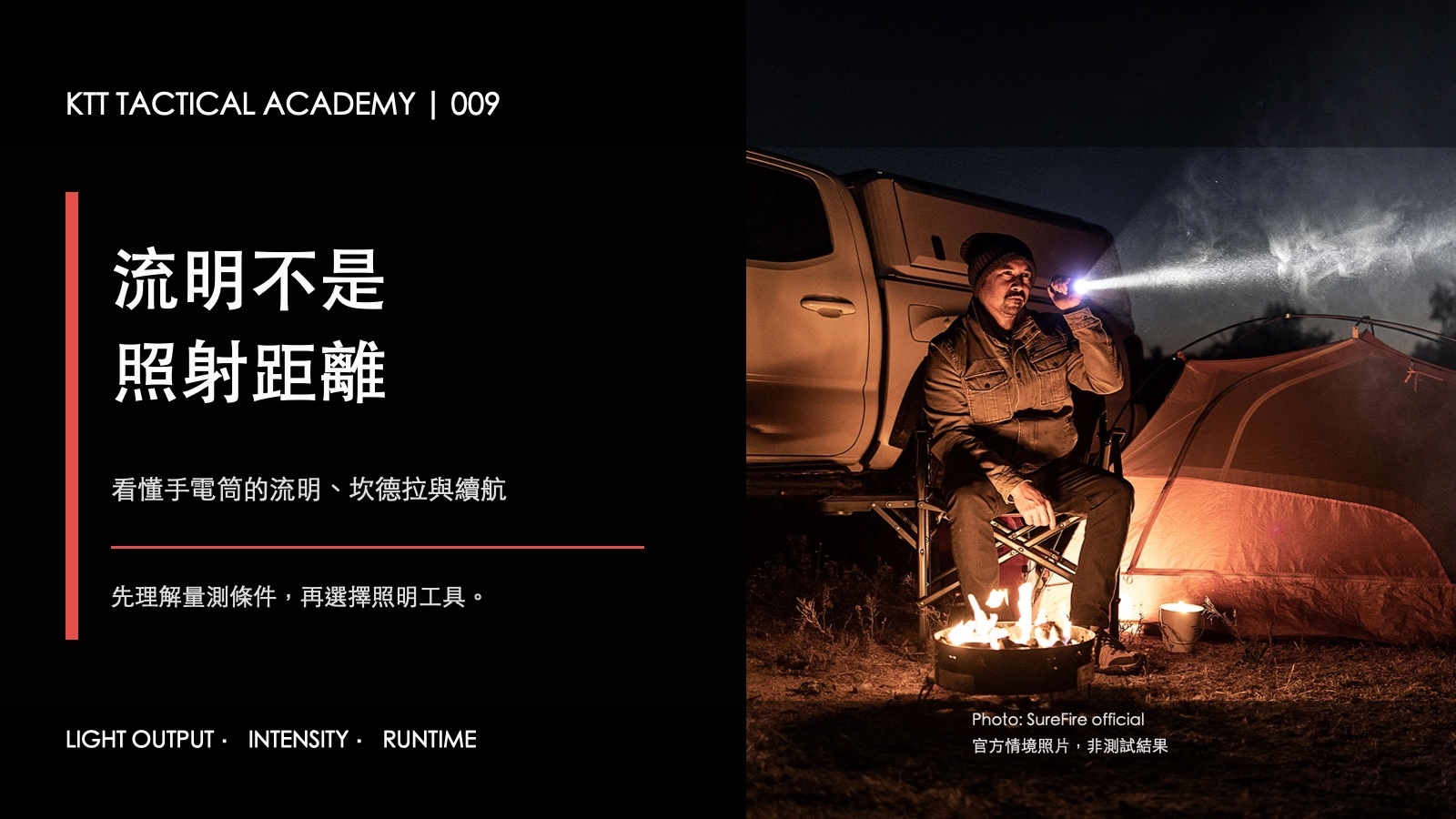
KTT Tactical Academy | 009 | Lumens Are Not Beam Distance
2026-09-12
International Tactical Knowledge Series
Why can two 1,000-lumen flashlights behave so differently—one lighting the ground nearby while another concentrates its beam farther away? Maximum output is easy to compare. The more useful question is whether a light supports the task, distance and duration that matter to you.
Image: official SureFire EDC1-DFT product photograph, illustrating handheld lighting. Not a KTT test image or independent verification of this model’s performance.
What the official information tells us
Lumens describe total output; candela describes intensity in a direction
Lumens (lm) measure luminous flux. A flashlight's peak beam intensity, expressed in candela (cd), describes its strongest direction. SureFire's beam-pattern guide explains how optics distribute the available light. A lumen rating alone therefore cannot determine reach: light can be spread more broadly or concentrated more tightly. Source: SureFire.
Rated beam distance is not a promise of detail recognition
Streamlight's FL 1 presentation explains beam distance using an illuminance threshold of 0.25 lux. This provides a measurement reference for comparison, not a universal guarantee that a user will recognize every object against every background at that distance. Reaching an object and seeing the required detail are different questions. Source: Streamlight.
Runtime has a measurement endpoint
The same presentation describes runtime ending when output falls to 10% of its initial value; a multi-hour rating does not promise maximum lumens throughout. In February 2026, PLATO announced the FL 1-2025 revision, including a test method for short-duration Turbo/Boost output. Check the standard version, mode and battery conditions stated for the actual product; the earlier explanatory document is not a complete rulebook for every new model. Sources: Streamlight, PLATO.
KTT Tactical Observation
1. Define the task before choosing the largest number
Organizing a pack, reading a label and illuminating a more distant trail sign require different fields of view. Our selection approach starts with three questions: what must be seen, at what distance, and for how long? Compare beam patterns and output modes against those requirements, rather than adapting the task to a headline lumen figure.
2. Evaluate the beam and the controls together
Looking only at the hotspot can overlook whether surrounding illumination suits close work. Looking only at the brightest moment after activation says little about access to the mode used most often. In a safe, controlled setting, check the beam, lower-output settings, grip and switch operation as you would normally use them. Avoid drawing conclusions solely from photographs taken with different exposure settings.
3. Ask about sustained output, not just time until dimming
For continuous work, ask whether the manufacturer provides an output-versus-time curve, whether automatic step-down occurs, and which batteries the figures describe. An absent curve does not prove poor performance; it means one runtime number cannot answer the sustained-output question. Include charging or replacement-battery arrangements in the usage plan.
Limits of this discussion
This article combines official public information with KTT's selection analysis. We have not independently tested products or reviewed the full paid revision of the standard. It does not establish certification, guarantee recognition at a particular distance, or validate a light for every outdoor or professional task. Verify the exact model, manufacturer instructions and restrictions. Nothing here makes an ordinary flashlight suitable for an explosive atmosphere.
A practical review sequence
Task and distance → beam pattern and lumens/candela → everyday mode → sustained output and runtime → battery arrangements → hands-on checks.
This week's discussion
Which would you most like to improve in your flashlight: coverage at close range, reach, or brightness consistency during extended use?