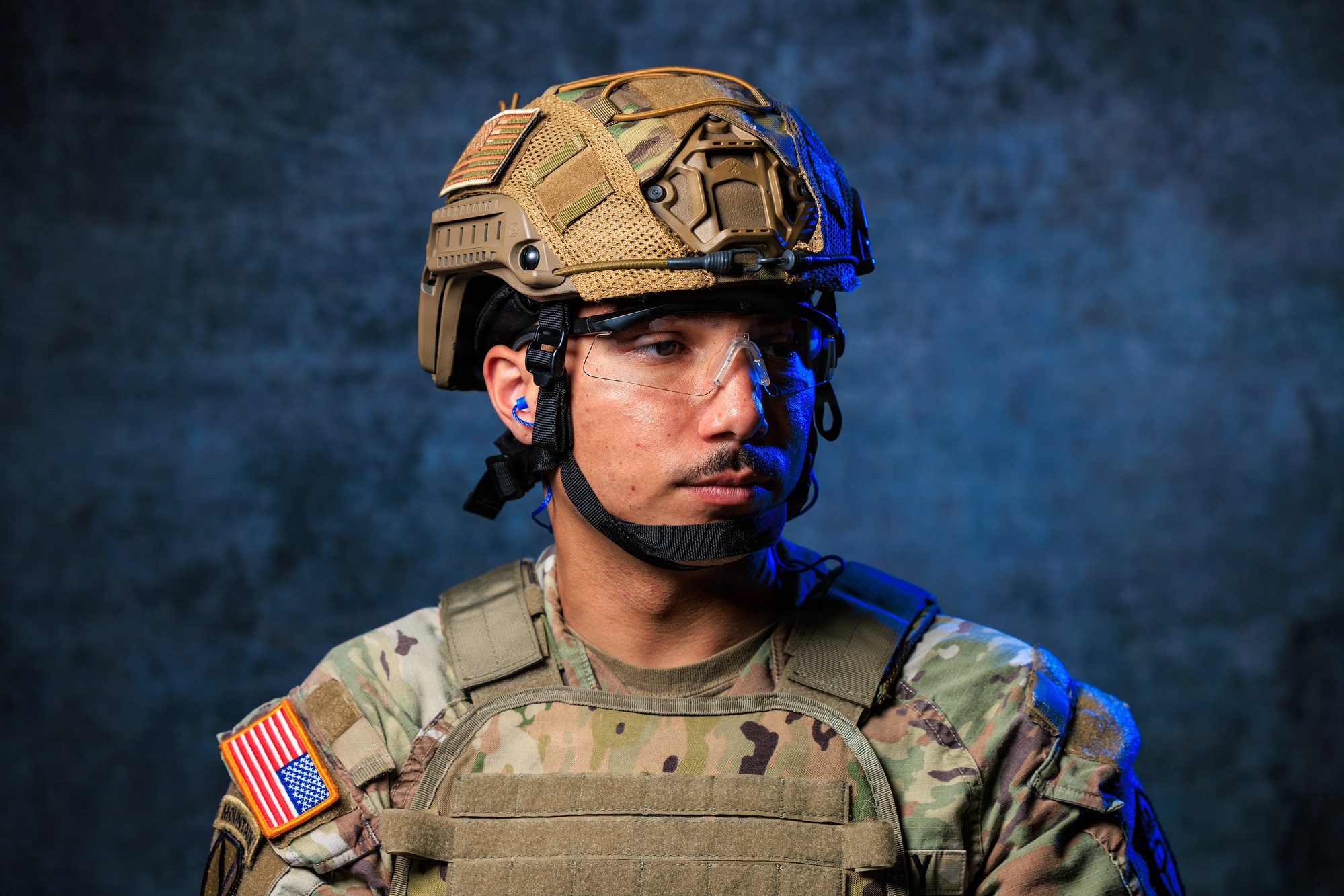
Does the NRR printed on a package equal the protection a user actually receives in the field? Not by itself. Real-world attenuation is affected by fit, sizing, eyewear, helmets, communications equipment and consistent wear. A rating is a selection input; fit determines whether the system is actually working for the individual.
A U.S. Army service member demonstrates properly fitted hearing protection. Source: Defense Health Agency-Public Health via DVIDS, Graham Snodgrass, 14 July 2026, Photo ID 9868196, PUBLIC DOMAIN. The image illustrates fit and equipment compatibility; it is not a KTT certification or product test.
What the official guidance confirms
NRR is a laboratory label, not a personal field guarantee
NIOSH states that the Noise Reduction Rating printed on hearing-protector packaging often does not represent the protection achieved by each worker. Its 2025 policy update recommends individual, quantitative fit testing to evaluate the attenuation a user actually receives, superseding reliance on the agency's older general derating guidance.
Fit-testing can produce a Personal Attenuation Rating (PAR) for a specific wearer, protector and fitting method. The same model can therefore produce different outcomes for different users.
Selection is not a contest for maximum attenuation
NIOSH recommends aiming for a protected exposure around 75–85 dBA and warns that overprotection can reduce awareness and speech intelligibility, encouraging users to remove their protection. Where commands, teamwork or equipment cues matter, protection, communication and situational awareness must be evaluated together.
Other equipment can change the seal
Eyewear temples, goggles, helmet suspension, straps, cables and cold-stiffened cushions can interfere with earmuff seals. Earplug results can change with size, insertion depth and fitting technique. A protector that appears correct by itself may not remain correct in the complete equipment configuration.
KTT Tactical Observation
1. Use the label to screen options, not to declare an answer
Start with the noise type, exposure duration and presence of impulse noise. Use the label to exclude clearly unsuitable options, then verify the exact product instructions, real fit and—where available—quantitative fit-test data. Laboratory NRR should not be presented as guaranteed field attenuation.
2. Conduct a dynamic check in the full configuration
Wear the eyewear, helmet, straps and communications equipment used in practice. Look down, look up, turn the head, speak and reproduce normal work movements. Check whether an eyewear temple lifts the cushion, an earplug loosens, a cable pulls the system out of position or the user cannot reliably restore the fit.
3. Include consistent wear in the selection decision
NIOSH frames selection around comfort, compatibility, convenience, communication and cost. Clamp pressure, heat, eyewear interference and operational complexity all affect whether a user keeps the device correctly fitted. A protector with high theoretical attenuation but poor wear compliance is not a dependable system.
4. Treat impulse and very high noise as separate risk questions
NIOSH recommends dual protection—earplugs under earmuffs—for exposures of 100 dBA or more and for impulse sounds. This general occupational guidance is not a guarantee for any weapon, blast or mission. Follow the site risk assessment, qualified professionals, organizational procedures and manufacturer instructions.
A practical verification sequence
Identify noise and exposure → check ratings and manufacturer limits → verify full-kit compatibility → perform a dynamic fit check → obtain quantitative fit testing/PAR → reassess periodically.
Limits
This article summarizes public NIOSH and DVIDS information. KTT has not performed acoustic, impulse-noise, durability, communications or mission testing on any referenced product. No specific protector is guaranteed to achieve its label value for every user or eliminate hearing-injury risk. Actual protection depends on exposure, fit, compatibility, maintenance and correct use.
This week's question
When using earmuffs or earplugs, which problem is most difficult for you: eyewear breaking the seal, long-duration comfort, or maintaining clear communication?
Sources checked on 26 September 2026. This is selection and fit education, not a substitute for occupational-hygiene assessment, hearing-health services, site rules or manufacturer instructions.