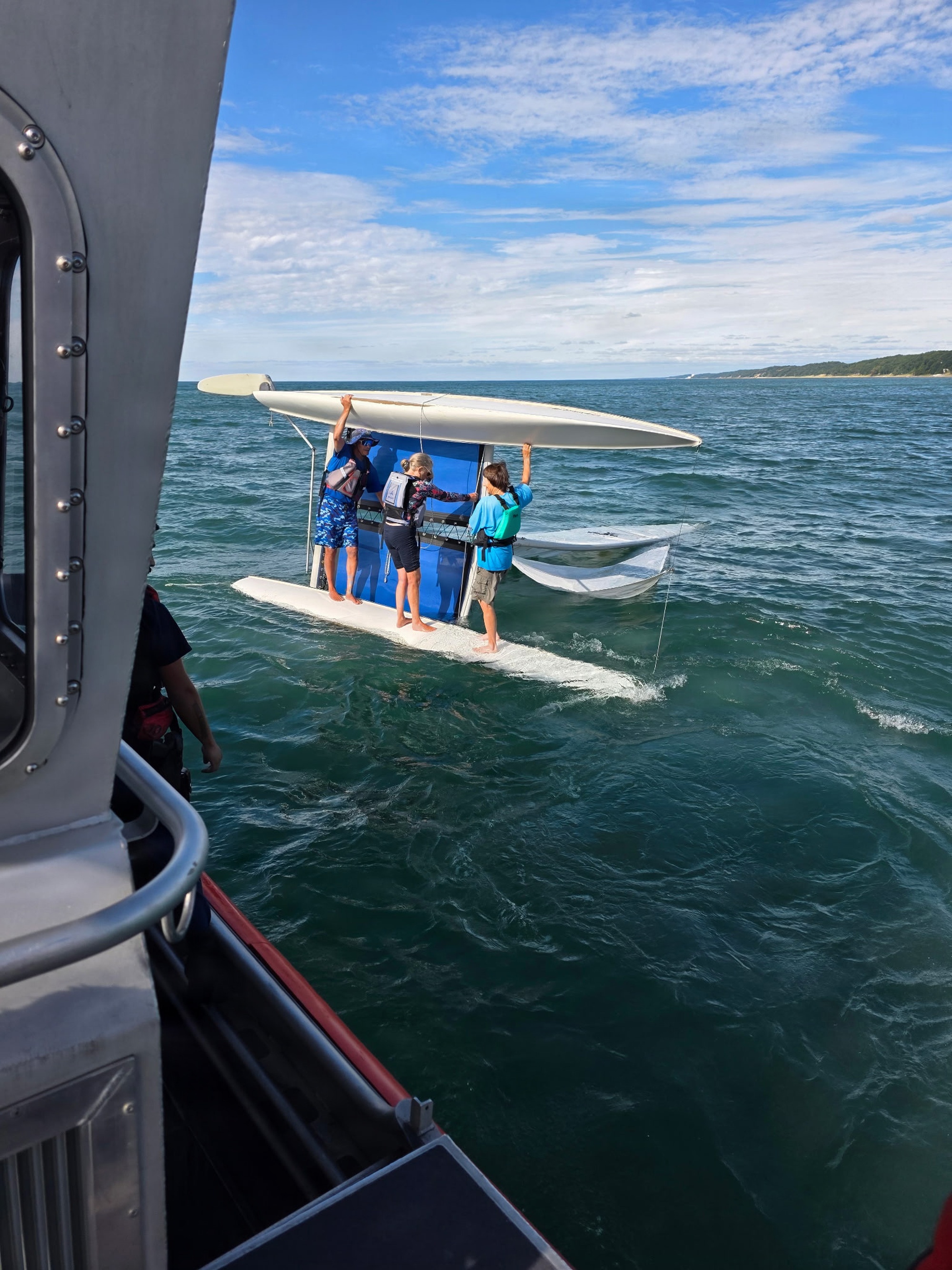
After a boat capsizes, which piece of equipment actually buys time for rescue? A three-person rescue on Lake Michigan on September 21, 2026, shows why survival should not be reduced to one device. Buoyancy, a visible reference point, location, reporting and responder coordination formed a chain.
Confirmed facts
U.S. Coast Guard Great Lakes reported on September 22 that a 16-foot catamaran capsized about half a mile offshore from Roadside Park in Coloma, Michigan. Two women and one man were aboard. Berrien County drone operators located the capsized vessel; all three people were wearing life jackets and holding onto the overturned boat.[1]
Coast Guard Sector Lake Michigan watchstanders received notice from county dispatchers at 3:59 p.m. A 45-foot Response Boat-Medium crew from Station St. Joseph reached the scene at 4:29 p.m. and recovered the boaters at 4:37 p.m. They were transported safely ashore.
The release did not identify the cause of the capsize, the life-jacket models, the communications equipment, the drone type, the water temperature or detailed medical outcomes. This article therefore does not credit one product for the result or speculate about the cause.
Incident image from September 21, 2026. A Coast Guard Station St. Joseph boat approaches the overturned catamaran while all three boaters wear life jackets. U.S. Coast Guard photo, courtesy Station St. Joseph; DVIDS Photo ID 9957212. The source page marks the image PUBLIC DOMAIN. Original image record.
Context
Michigan Department of Natural Resources boating guidance separates several layers of readiness: wearing a properly fitted life jacket, checking the vessel and equipment, filing a float plan, maintaining a lookout, and carrying a mobile phone or marine radio.[2]
Michigan's life-jacket guidance also distinguishes between different PFD types and use cases. The practical point is not merely to have a device somewhere aboard, but to select the correct fit and type, keep it serviceable and accessible, and wear it where required.[3]
The National Weather Service notes that changes in wind, waves, visibility and thunderstorms can rapidly change risk on the water, and recommends checking current marine forecasts and warnings before departure. This is general safety context; the incident release did not establish weather as the cause of this capsize.[4]
KTT Tactical Observation
1. Worn flotation is different from stowed flotation
A sudden capsize may leave no time to retrieve and don equipment. The confirmed fact in this case is that all three people were already wearing life jackets. That supports a readiness principle: equipment must be correctly fitted, serviceable and in use before the unexpected happens. The public record does not support conclusions about a specific model or rating.
2. Staying with the overturned hull helped preserve a search reference
The three boaters held onto the overturned vessel, which county drone operators located. A hull can provide a larger search reference and temporary support than an individual in the water. Whether staying with a vessel is appropriate still depends on fire, drift, sea state and hull condition; this article is not an on-scene procedure.
3. Location was only one link in the rescue chain
The drone helped establish position, county dispatch passed information to the Coast Guard, and the response-boat crew completed the recovery. Any handoff can slow down if the position, terminology or receiving authority is unclear. For operators and suppliers, the readiness discussion should therefore cover who reports, how location is described, who receives the information, and what backup channel exists.
4. Preparation preserves options after the incident
Weather monitoring, a float plan, communications, life jackets and equipment checks address different failure points. None guarantees prevention or rescue. Together, however, they can preserve more options when conditions deteriorate. The useful system is not a single hero product; it is a chain without one fragile point of failure.
Limits and cautions
No public investigation finding was cited in the Coast Guard release. It would be inappropriate to assign the cause to vessel design, operator action or weather. A successful recovery also does not establish that the same equipment will produce the same result in every water temperature, sea state, distance from shore or response time.
This article uses a U.S. case and public guidance from Michigan and the National Weather Service to discuss readiness. Regulations, PFD standards, communications channels and rescue capacity vary by jurisdiction. Follow current local requirements, forecasts and professional training.
This week's question
If you could strengthen one link in a small-boat safety setup first, which would it be?
A | Properly fitted life jackets worn by everyone
B | A float plan and overdue-reporting rule
C | Reliable communications and location reporting