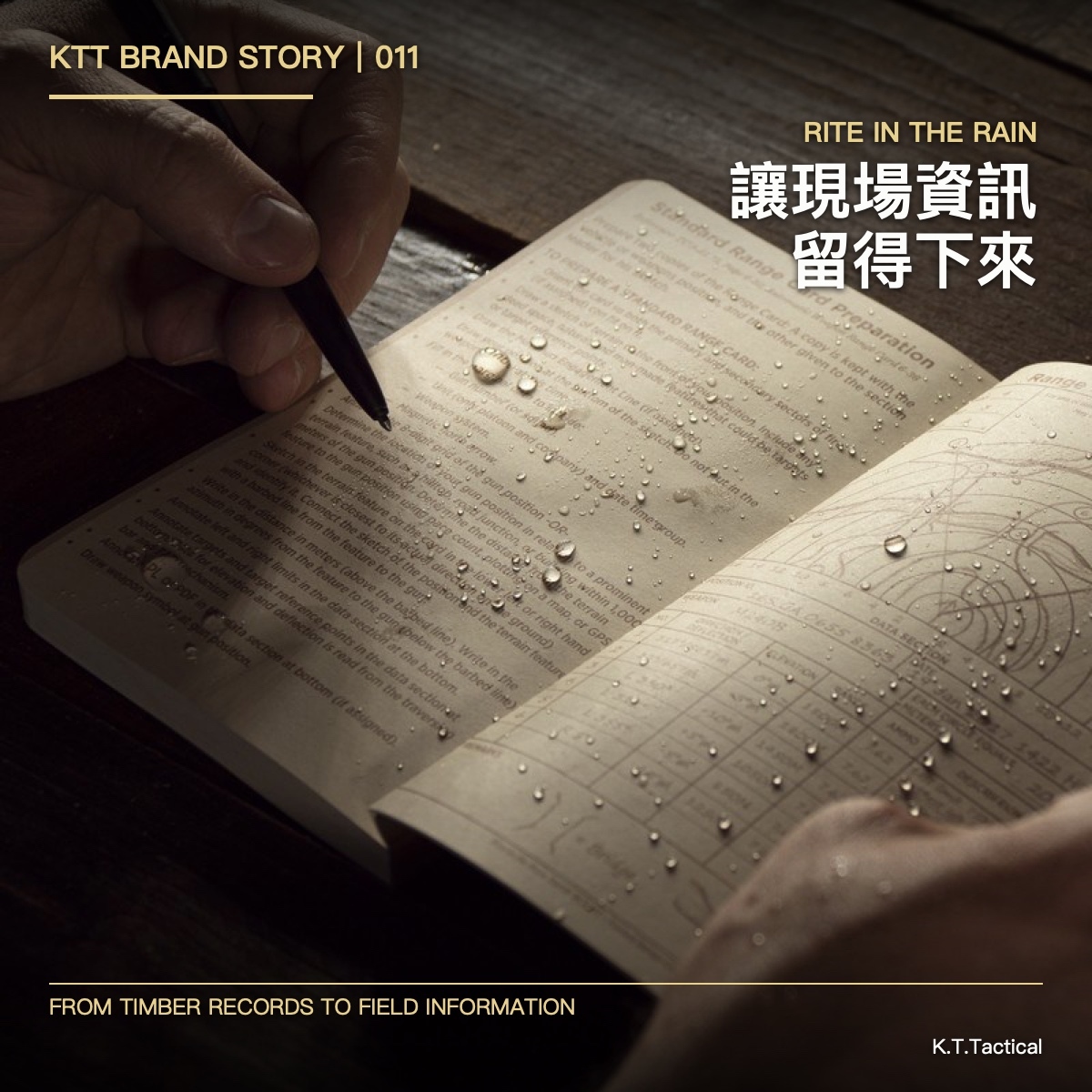
Issue cover created from Rite in the Rain official brand material; not a KTT product test or operational record.
When rain erases the writing, do we lose a page or a link in the information chain?
Measurements, locations, times, handover notes and treatment records may occupy only a few lines. In outdoor work, engineering, public safety or operational environments, however, those lines can be the starting point for someone else's next decision. When the work cannot wait for a dry room, paper becomes more than stationery. It is the part of the information system closest to the user.
Rite in the Rain began with that practical tension: work was already taking place in wet weather, so how could the record remain usable? This article uses the company's documented history and the design of its Tactical Field Book to examine the broader recording system. Brand history is not treated as test evidence, and no single product is presented as a guarantee for every environment.
From timber records in the Pacific Northwest
According to the official Rite in the Rain history, Alec Polson of Washington's Polson Lumber Company posed a field problem to Jerry Darling in the early twentieth century: was there a better way to record log scaling and lumber tallies in the wet Pacific Northwest? Timber cruisers commonly wrote on the smooth side of painted shingles, and preparing and storing those tally boards consumed time and space.
The official account says Darling later connected with printer Herbert Buffington and developed paper intended to withstand severe rain. The company began in Raymond, Washington. Between 1916 and 1930, its early process involved dipping sheets, hanging them and advancing drying rods by hand. The useful lesson is not simply a romantic origin story. The company began around a specific operational requirement: a recording medium that was easier to carry, write on and preserve in the conditions where the work happened.
Image source: Rite in the Rain official history page. The portrait is identified as Jerry Darling.
From all-weather paper to a field recording system
In its official company story, Rite in the Rain says its Tacoma factory has produced all-weather notebooks since 1916 and that a special coating helps prevent water from smearing notes. The company also distinguishes compatible writing tools: a standard pencil or an all-weather pen can be used on wet or dry paper. Paper does not operate in isolation; the writing instrument remains part of the system.
The official Tactical Field Book No.980T page extends that idea to operational information. A Field-Flex cover, perfect binding, weatherproof glue, a universal page pattern and reference material such as rulers, conversions and map scales are intended to support both physical use and more consistent recording.
These are manufacturer-published features and specifications, not KTT verification of durability, water resistance, binding life or suitability for a particular operation. A responsible choice still depends on the exact model, page format, writing instrument, carry method and local procedure.
Image source: Rite in the Rain official brand material. It illustrates the all-weather notebook concept and is not a KTT test result.
KTT Tactical Observation
The following is KTT systems analysis, not a product test. For people who must record information outdoors, in rain or under pressure, reliability rarely comes from one sheet of paper. At least four links matter.
1. Define what information cannot be lost
Coordinates, time, quantity, casualty data, observations and handover details have different tolerances for error. Defining the essential fields first helps determine the useful page format. Good material cannot compensate for critical information that has no consistent place.
2. Treat paper and writing tool as a pair
Environment, paper surface and ink or lead behavior all affect legibility. Test the instrument you will actually carry under the humidity, temperature and writing posture you expect. The phrase “all-weather” should not be used to assume universal compatibility.
3. Binding and carry method affect availability
Where the notebook sits, whether it can be accessed with one hand, how other equipment presses against it and whether it returns to a consistent location all influence whether the record remains available. Material choice addresses environmental risk; carry habits address human risk.
4. Important information still needs handover and backup
Weather resistance does not prevent loss, and one copy is not always enough. Teams may need a defined method for transcription, photography, digitization or acknowledged handover. Paper can be a dependable starting point without becoming the only endpoint.
Limits and use notes
This article draws on Rite in the Rain's official history, company story and No.980T specifications, together with the related product currently listed by K.T.Tactical. Manufacturer sources are not independent third-party tests. We have not tested immersion, abrasion, weather exposure, writing-tool compatibility or long-term preservation, and make no waterproof-rating, permanent-record, operational-suitability or safety guarantees. Check the exact model, manufacturer guidance and applicable organizational procedures before use.
Every Brand Has A Story.
From a timber cruiser's tally board to coordinates, times and handover details in a field notebook, the central question remains the same: how does information survive the environment in which it is created? Every Piece of Gear Has A Reason.
If you were improving a field recording process, would you begin with paper, writing instrument, page format, or handover and backup?