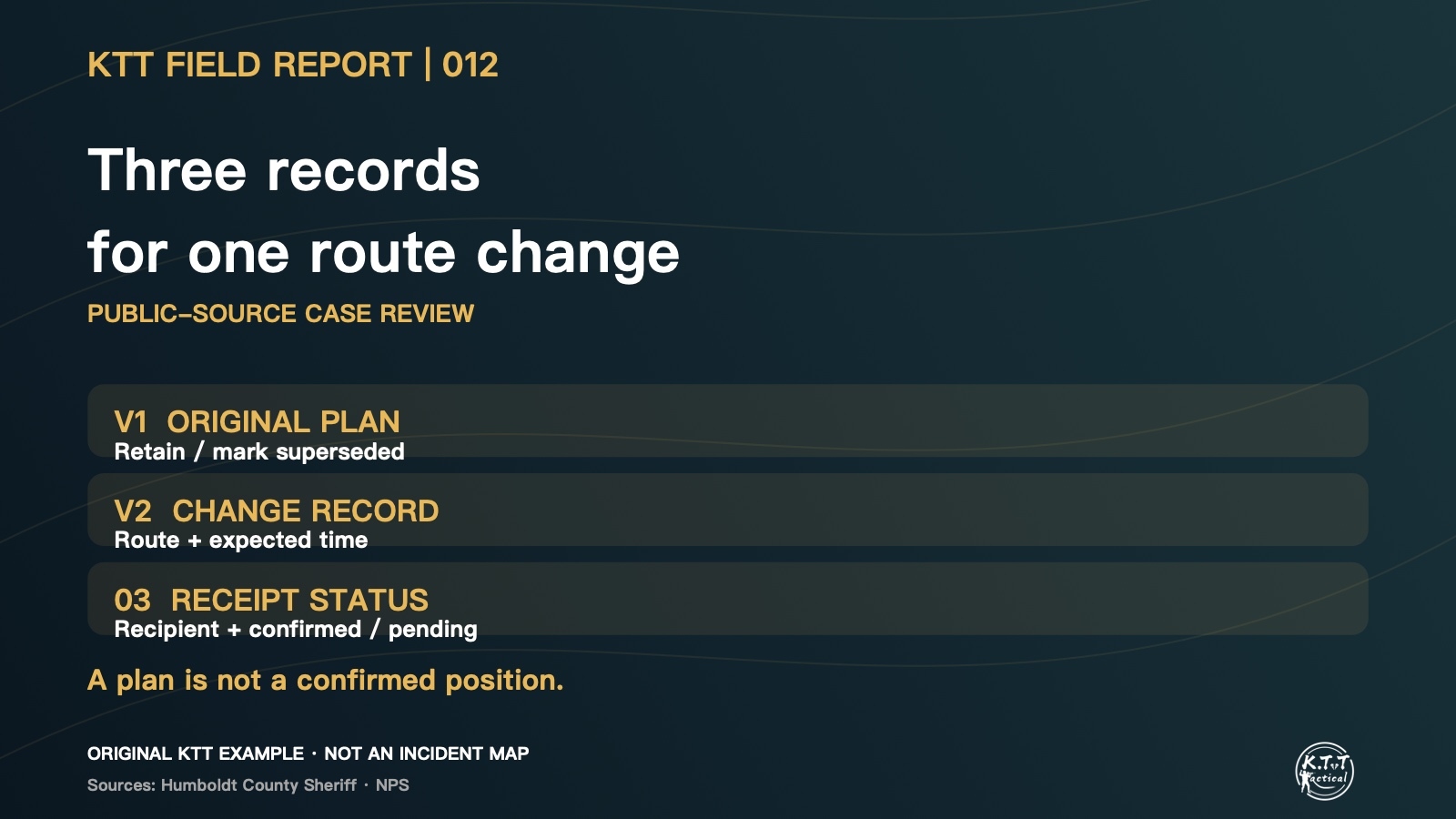
Original trip-version example with fictional labels; not records from this incident.
A route changes, but the group chat still contains two maps and three expected return times. Which plan should the person at home use? Following our previous report on trip handovers, this issue focuses on identifying the current version when plans change.
Confirmed facts: a family member received a message asking for help
In an October 9, 2026 release, the Humboldt County Sheriff’s Office described an overdue hiker near the Ossagon Trail the previous day. A family member received a text saying he was lost and sought help. A coordinated search located him early the next morning; the walk out still took several hours. [1]
The release does not establish that he changed routes or failed to update a plan. We use the case as an entry point for discussing information handovers, without assigning a cause.
Background: tell your trusted contact when plans change
The U.S. National Park Service recommends sharing your destination, activity and return time with a trusted contact who is not travelling with you. Notify that person when activating a backup plan and after completing an activity. [2][3] This is independent planning guidance, not an investigation of the Humboldt incident.
KTT Tactical Observation: make each change a complete update
The following is a KTT recordkeeping example, not an official form or rescue procedure. Give each plan a recognisable version label and connect the previous plan, the changes and the receiving status. Your contact should be able to see which version replaces which.
1. Identify the version being replaced
For example, mark “Trip A — update 02” as the current plan and state that it replaces update 01. Retain the earlier record with a superseded label. Match the version label to its map or written description. A file named “latest” can become ambiguous after the next change.
2. Describe the changes together
State which planned section or exit changes and whether the expected return time changes too. Note what remains the same. Planned locations are not confirmed positions. A familiar place name should still point to an identifiable map version.
3. Separate sending from acknowledgement
Sending an update does not establish that your contact received, opened or understood it. Keep the sending time, intended recipient and acknowledgement separate. Leave an unconfirmed update labelled as such. Do not silently replace the last acknowledged plan with a file whose receipt is unknown. Keep real contact details and private itineraries out of public examples.
4. Keep actual reports distinct from the plan
If a later message reports arrival at a location, retain its source, receipt time and original wording separately. Distinguish a first-hand report from a relay. That preserves the difference between a planned destination, a reported location and information that still needs confirmation.
Limits and interpretation
The release does not disclose the full plan or communication history. It cannot show whether version records or particular equipment would have changed the outcome. KTT did not attend the incident and makes no estimate of time saved. A trip plan cannot guarantee safety or rescue, and completing one is not a prerequisite for seeking emergency help. [3] Follow the relevant local authorities and responding agencies.
This week’s discussion
Which would you improve first: a clear version label, a concise record of route and time changes, or acknowledgement from your trusted contact?
Next Field Report: when a report contains only partial information, how can confirmed positions and inferred routes stay separate?
Sources checked October 22, 2026, Asia/Taipei. Original KTT version-handover illustration; not an incident map, participant document or scene photograph.