Do one-, two- and three-point slings form a simple ladder from basic to advanced? No. The number mainly describes attachment and routing, not quality. The useful question is which priority comes first: freedom of movement, long-duration carry, control when hands are released, or positional support.
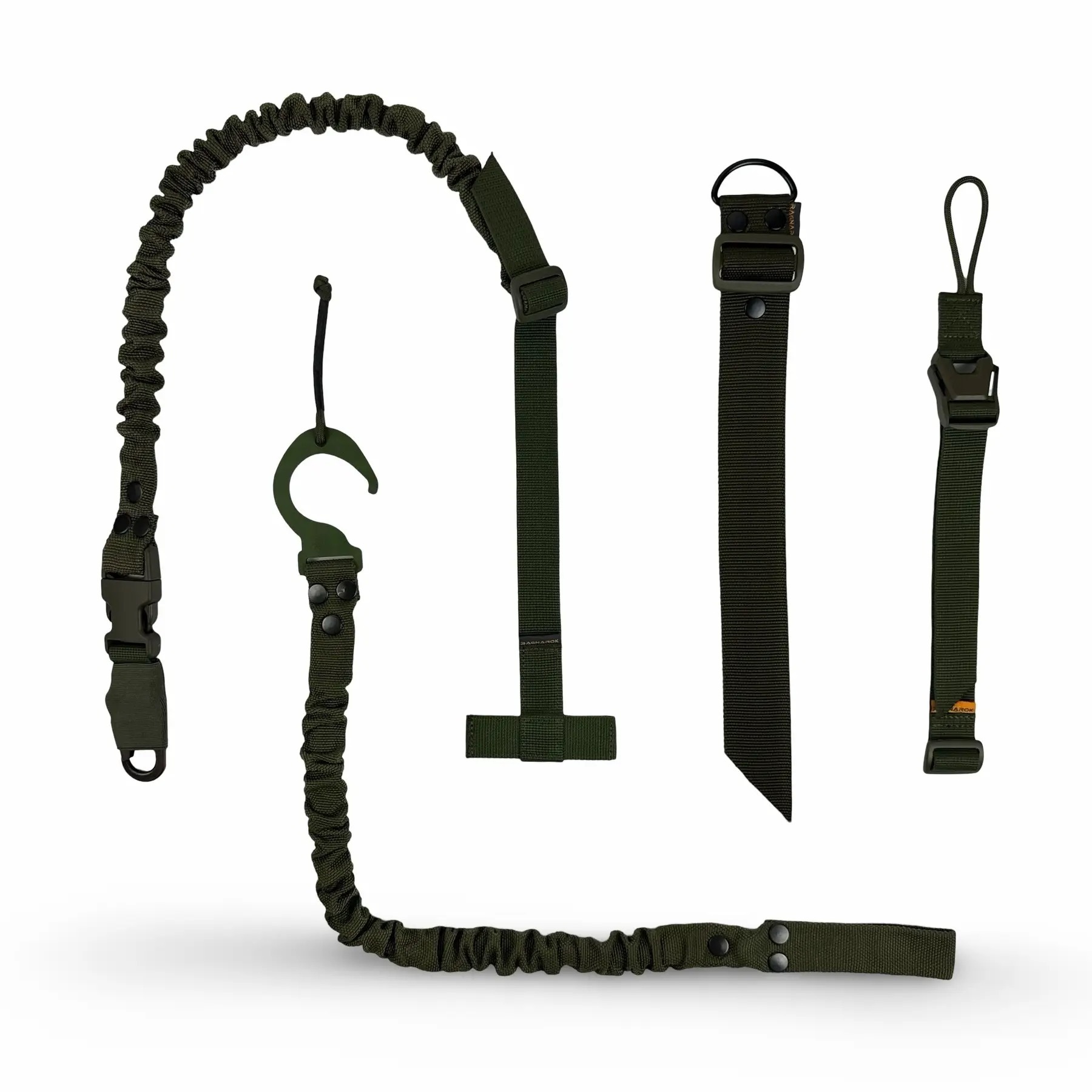
Ragnarok THOR single-point tactical sling kit product photograph from the K.T.Tactical product page. Used to illustrate configuration; not KTT tensile, fatigue or mission testing.
What the official sources tell us
One point: freedom of movement, with a separate control question
RAGNAROK describes a single-point sling as connecting at one position. Its THOR system integrates directly with MOLLE-compatible plate carriers and load-bearing equipment. The simpler path can reduce webbing restriction when changing direction. Sources: RAGNAROK single-point slings and THOR set.
Freedom of movement does not guarantee that equipment will remain close to the body when released. Hanging position, sling length, body size and other equipment all affect swing and contact. The THOR set includes a separate retention accessory, reinforcing an important distinction: the primary sling and secondary retention solve related but different problems.
Two points: distributed carry and adjustable body control
A two-point sling connects at two positions on the equipment. RAGNAROK's official overview associates this layout with more balanced weight distribution and stable carry; individual products then add quick adjustment, elastic sections or padding. Sources: RAGNAROK sling overview and dual-point slings.
Two attachment points can make it easier to tighten equipment against the body or loosen it for working space. The trade-off is the need to check adjustment range, mounting positions and interference with equipment worn on the chest. A quick-adjust feature matters only if it remains reachable and usable with the intended clothing and load carriage.
Three points: more routing and retention, with more complexity
RAGNAROK's three-point guide describes a layout with front and rear equipment attachments plus a sliding third section along the main strap. It supports multiple carry positions and greater retention, while the manufacturer also notes the learning requirement and possible inconvenience in confined spaces. Source: RAGNAROK three-point slings.
Three points therefore do not mean “better than two.” Where multiple carry positions and secure retention are central requirements, the complexity may be justified. If a user cannot reproduce the setup while wearing gloves, armour and other equipment, the added routing can become a burden.
Carry and positional support are not the same function
U.S. Marine Corps MCRP 3-01A distinguishes the hasty sling from the loop sling. The hasty sling can be acquired quickly and adds stability; the loop sling offers greater support but takes longer to don and has limited combat application. Source: U.S. Marine Corps MCRP 3-01A.
The distinction matters because one sling may contribute to carry, hands-free retention and positional support, but one adjustment will not necessarily optimize all three. Define the primary job before comparing configurations.
KTT Tactical Observation
1. Rank priorities before selecting the point count
Ask four questions: how quickly is movement space needed, how close must equipment stay when released, how long will it be carried, and is positional support required? Without priorities, selection easily collapses into comparing generic claims such as “fast” or “stable.”
2. Mounting positions matter as much as sling type
The same two-point sling can behave differently with different attachment locations. A plate-carrier-mounted single-point system must also be checked against shoulder straps, communications cables and backpack straps. A model name cannot replace a whole-system fit check.
3. Quick release is a system, not just a button
The practical value of a release depends on identification, access with gloves, and what happens to the equipment and webbing after release. Fit and adjustment work should be performed with unloaded, cleared equipment, following site rules, unit procedures and manufacturer instructions.
4. Test with the complete load carriage
Wear the carrier, jacket, belt, gloves and pack normally used. Check adjustment access, neck contact, movement against the legs, interference with other equipment, and left- and right-side use. Configuration differences often become clear only when the full load is present.
A simplified comparison
Configuration
Common priority
Check carefully
One point
Movement freedom and simple routing
Swing when released, body retention, plate-carrier integration
Routing complexity, learning burden, entanglement in confined spaces
This is a selection starting point, not a performance ranking. Results still depend on equipment dimensions, mounting, adjustment, clothing and training.
Limits of this discussion
This article combines official public material with KTT's selection analysis. We have not conducted tensile, fatigue, release-cycle or mission testing on the products discussed. Manufacturer statements about materials, use and comfort are not third-party certification, and no configuration can be assumed suitable for every platform, body type or duty. Verify the exact model, hardware, load restrictions, equipment-manufacturer guidance and local law.
A practical selection sequence
Primary task → control when released → carry duration → mounts and equipment interference → adjustment/release access → full-load fit check with unloaded, cleared equipment.
This week's discussion
Which trade-off is hardest for you: movement freedom, control when released, or comfort during extended carry?