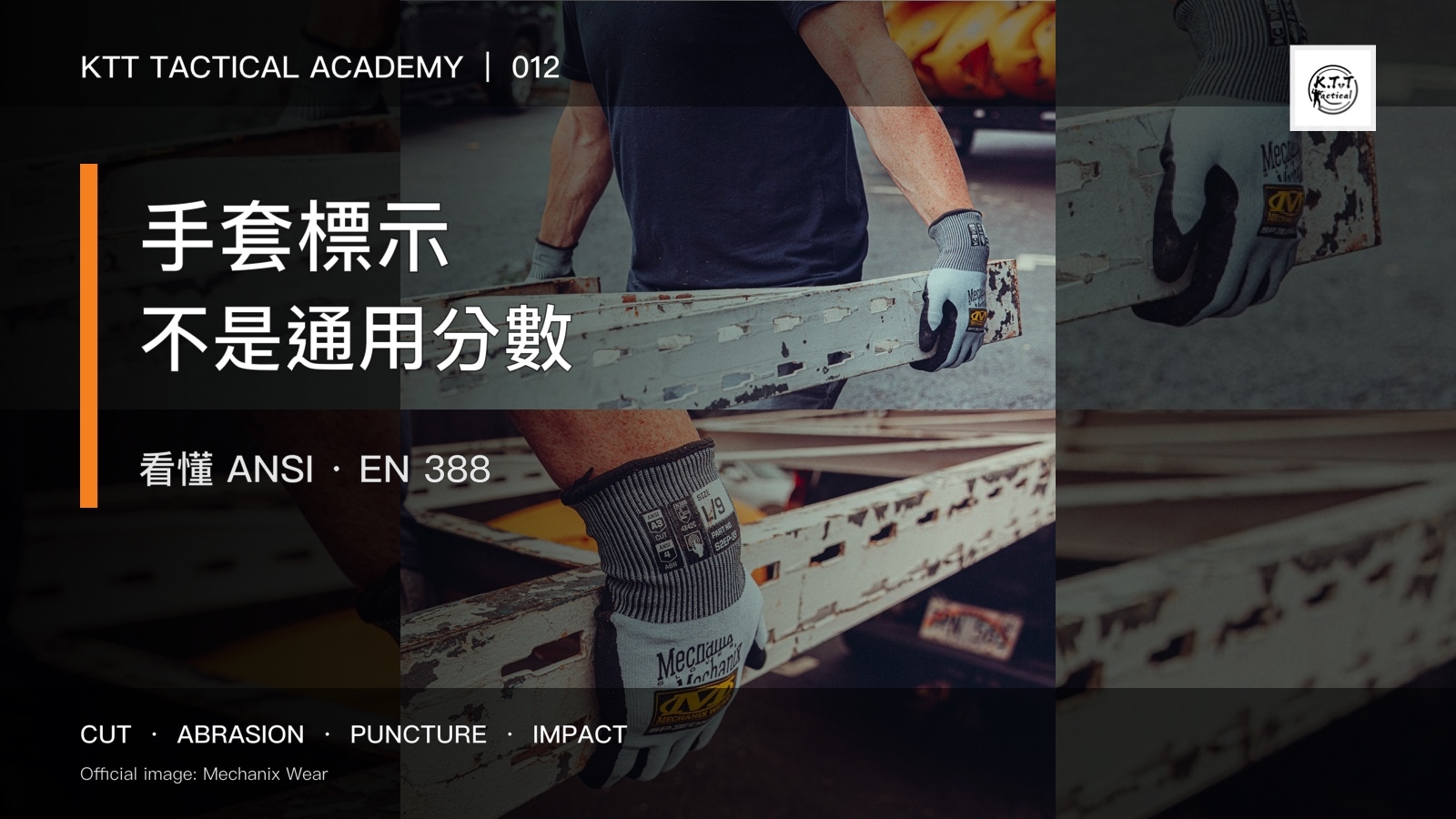
KTT Tactical Academy 012 | Reading ANSI and EN 388 glove markings
International Tactical Knowledge Series
Can markings such as A3, A5, 2121X or 2121XP be arranged into a single “higher number means safer glove” ranking? No. These codes come from different standards and test properties. They describe performance under defined conditions—not universal protection across every hazard, task or area of a glove.
What the official sources confirm
Start with the hazard, then select the glove
OSHA 29 CFR 1910.138 requires hand protection to be selected for the task, conditions, duration of use, identified hazards and potential hazards. OSHA's selection guidance further explains that no glove protects against every hand hazard. Cut, abrasion, puncture, chemical, thermal and impact risks must be evaluated separately.
ANSI/ISEA 105 A1–A9 classify cut resistance
ANSI/ISEA 105-2024 uses cut levels A1 through A9, based on the force required to cut through a material in the specified test. A1 begins at 200 gram-force and A9 corresponds to 6,000 gram-force. This is a cut-resistance classification. It is not automatically a needle, chemical, thermal, impact or whole-glove rating.
An EN 388 string is a set of properties, not one score
EN 388:2016+A1:2018 presents a sequence of numbers and letters for mechanical-risk testing. EU-OSHA describes the sequence as abrasion, circular-blade cut, tear, puncture, ISO 13997 straight-blade cut and an optional impact result. A final P indicates that the impact test was passed; X generally means a property was not tested or is not applicable. Reading 2121XP as a single “level 2121” discards what each position means.
ANSI and EN cut labels are not universal conversions
Both systems can use the ISO 13997/TDM method, but their classification bands and label formats differ. Mechanix education material presents ANSI A9 and EN Level F as comparable highest cut classes. That comparison concerns the cut test only; it does not transfer abrasion, puncture, impact or task suitability.
KTT Tactical Observation
1. Read the full marking before the product category
Terms such as “tactical,” “cut-resistant” or “heavy-duty” are product positioning, not complete test reports. Verify the exact model, marking edition, applicable standard and each performance field. Materials, years and regional variants within one product family may differ.
2. Separate the hazard into individual questions
Sharp-edge handling may require both cut and puncture performance. Vehicle maintenance can combine abrasion, oily grip and back-of-hand impact. Precision work depends on palm thickness, seams, sizing and tactile control. A high cut level does not automatically fill the other gaps.
3. Confirm coverage and the complete equipment setup
Some products place cut-resistant material only in the palm; others specify 360-degree coverage. Back-of-hand TPR, palm padding and finger structures may have separate claims. Check fingertip space, thumb-web tension and cuff security, then test normal tool handling, buckles, touchscreens and wet or dirty surfaces.
4. Treat wear inspection and replacement as part of protection
Holes, cuts, failed seams, hardened palm material and contamination can make a label irrelevant in practice. OSHA guidance calls for reassessing hazards and the suitability of previously selected PPE. Inspection, cleaning, replacement and training cannot be replaced by one number on the package.
A practical selection sequence
Identify hazards → confirm the exact model and standard edition → decode every marking field → verify coverage → conduct a full-kit dynamic fit check → define inspection and replacement criteria.
Limits
This article is label-reading and risk-selection education. KTT has not performed laboratory, duty, shooting, chemical, thermal or puncture testing on any referenced glove. It does not establish that a model prevents all cuts or is suitable for needles, chemicals, flame or rotating machinery. Gloves can create entanglement hazards around moving equipment. Follow the site risk assessment, organizational procedure, conformity documents and manufacturer instructions.
This week's question
When selecting gloves, which factor do you check first: dexterity, cut and puncture protection, back-of-hand impact, or abrasion life?
Sources checked on 26 September 2026. This article does not replace workplace risk assessment, organizational procedures, conformity documentation or manufacturer instructions.